The City Council brings local biodiversity closer to schoolchildren with scientific banding days at the Parque de las Mesas
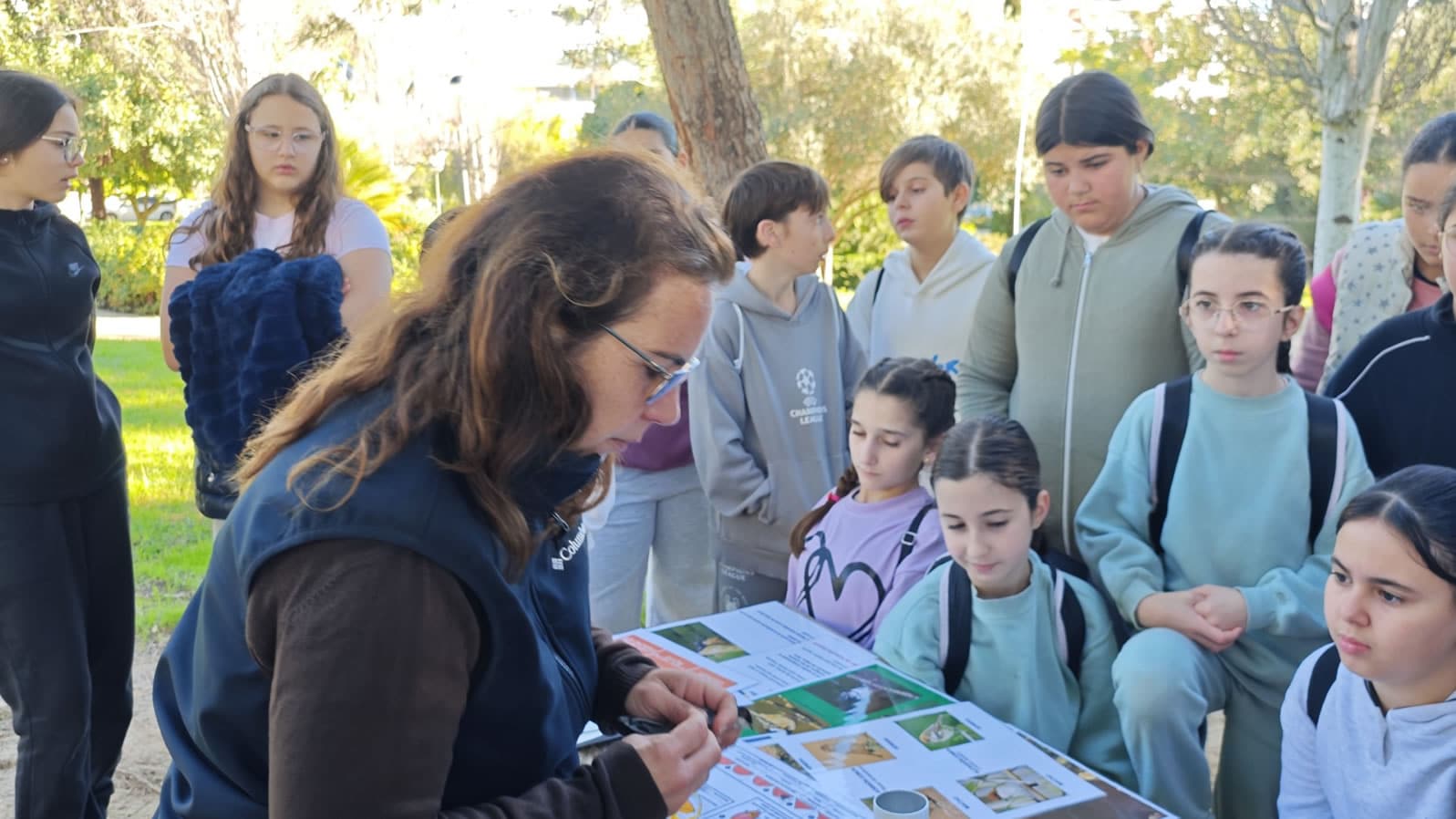
The Environment Delegation coordinates this initiative in collaboration with the Strait Ornithological Group.
The City Council of Estepona reports that the delegation of Environment has launched a scientific bird banding days aimed at schoolchildren in 5th and 6th grade of primary school in the municipality, with the aim of promoting knowledge and respect for biodiversity from an early age.
This activity is organized by the delegation of Environment in coordination with the Ornithological Group of the Strait (GOES), whose accredited specialists will be responsible for developing the technical and scientific work, since they are the experts responsible for the process of capture, banding and data collection.
The initiative will allow students to acquire a deeper knowledge about the fauna that inhabits their immediate environment, favoring that in adulthood they are more identified and committed to the conservation of the natural world. The aim of this proposal is for schoolchildren to learn to identify and value the species with which they share their daily space, since on many occasions more is known about distant fauna than about that which is part of their own environment.
These days will be held in the Parque de Las Mesas, an urban enclave that provides easy access from the various schools in the municipality and offers an ideal environment for the development of the program.
The city of Estepona, located in a clear migratory route between Europe and Africa, becomes a strategic point for the sighting and study of different species during the autumn period. Therefore, the activity will be carried out over a month during the migratory stage, with an approximate duration of an hour and a half per class.
The program is divided into several phases. First, the students will attend an introductory talk that will allow them to get acquainted with the journey. Subsequently, they will be divided into two small groups (of no more than 12 students) to witness first-hand the two fundamental parts of the process: the capture of the birds by means of mist nets installed early in the morning and the subsequent scientific banding.
The specialists of the Grupo Ornitológico del Estrecho (GOES) will carry out a complete check-up of each bird, assessing its health, weight and biometric measurements such as wings or beak.
After the data collection, a metal ring will be placed on the bird’s leg before returning it to its natural habitat.
The data collected will be integrated into scientific databases of international dissemination, which will allow us to increase our knowledge of the species observed. Likewise, this information will be provided both to collaborating institutions and to the Estepona City Council, which will thus have valuable data on local biodiversity.
With this initiative, the Consistory reaffirms its commitment to environmental education and conservation of the natural environment, promoting among young people a greater awareness of the need to live together and protect the ecosystem as a fundamental part of life.
New Apartments

New Houses

Featured Properties



More news
The Children’s Room ‘Elvira Lindo’ of the Padre Manuel Cultural Center Library hosts the storytelling ‘Stories that embrace the heart’, by the teacher Vanessa López Morales.
The activity is recommended for children between 3 and 8 years old, and will take place on Thursday, February 26, at 11:30 a.m., with free…Nearly twenty composers of various nationalities compete in the V Composition Contest for Symphonic Band ‘Estepona, Garden of the Costa del Sol’, endowed with 10,000 euros.
The contest, open to musicians of any nationality, aims to motivate great composers to create symphonic works inspired by the city of Estepona. The Estepona…The Plenary approves the compatibility of municipal land use, bringing to more than 1,200 the number of subsidized housing units that can begin to be built
The City Council, after adhering to the Housing Decree of the Junta de Andalucía, can project almost a thousand VPOs on municipal land that until…