Great icons of the summer made in marble star in the exhibition 'Quiñones: To the Origin' at the Mirador del Carmen
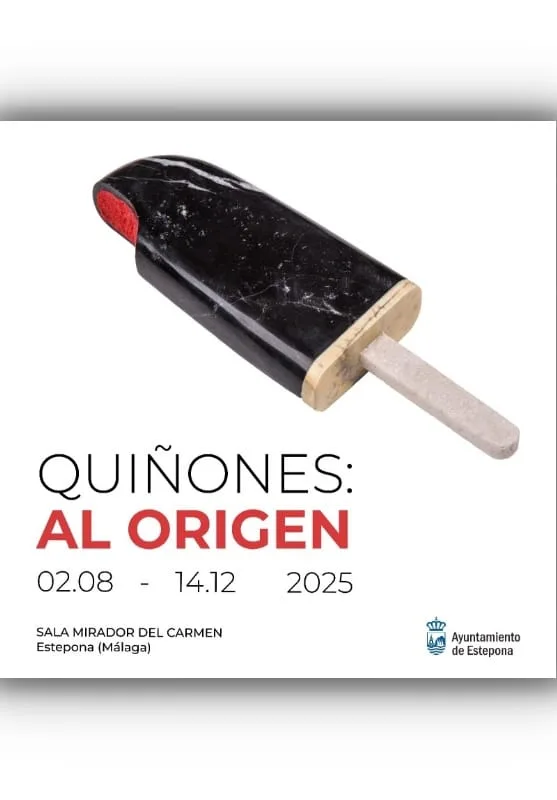
This is the first solo exhibition in the city of the artist Juan Miguel Quiñones, who has a great international projection for his monumental marble simulacrums of summer objects.
The Estepona City Council informs that this Friday will be inaugurated the exhibition 'Quiñones: Al Origen' at the Mirador del Carmen. This is the first solo exhibition dedicated to the artist Juan Miguel Quiñones, who has obtained a great international projection and outstanding reviews for sculpting monumental marble simulacra of very representative objects of the summer.
This exhibition, which can be visited by the public from Saturday, August 2, brings together 180 pieces sculpted in marble that represent great symbols of the summer season such as ice cream, beach toys, diving fins, surfboards or scooters.
Quiñones' sculptures, made in the noble material par excellence of the classical tradition, produce monumental simulacrums, on a real or oversized scale, of all those objects that are great icons of the summer and that are part of the sentimental memory of the spectators who visit the exhibition.
The curators of the exhibition, Mariella Franzoni and Flor Reiners, point out that "the utopia of summer and the time stopped between beach, sun and play" are the protagonists of this exhibition in which we can enjoy sculptures made using different techniques: from cutting with diamond saws to Renaissance-style inlay. Both consider that all this artistic production is "the result of a practice deeply connected with the tradition of stonemasonry and manual marble work, and influenced by the quarries of Vejer de la Frontera, the artist's hometown.
The exhibition, which can be visited until December 14, is proposed as a symbolic reunion between the artist and Estepona, the city where he grew up and develops his work, and at the same time as the crossing of two parallel views: one towards the work of a sculptor who, by turning marble into a ductile material, has erected a cult around the iconic objects of the childhoods of the 1990s; the other, towards the recent history of a territory (the Costa del Sol), which has nourished the style of widowhood and the collective memory of those who have inhabited this landscape reinvented for the consumption of a summer utopia.
Through a wide selection of works – some created expressly for this exhibition and others from private collections – the exhibition is structured in six thematic nuclei: Origin, Sketches, The Summer Factory, Punta de la Plata, Sea and Mountains, and When the Sun Warms Up. Six scenes or fragments of an emotional topography that intertwine the artist's personal memory with the city's collective urban imaginary.
Within the framework of this encounter, the work of Juan Miguel Quiñones is closely linked to the history of a region of the Andalusian Costa del Sol and its "architecture of pleasure" -in the words of Henri Lefebvre and his Spanish disciple, Mario Gaviria-. "That is to say, of that tourist urbanism that, starting in the 1960s, configured new landscapes designed for leisure and consumption, projecting unprecedented ways of inhabiting, feeling and thinking the world from peripheries that, during the summer months, become objects of desire for the inhabitants of the big European and global cities in search of rest," according to Mariella Franzoni and Flor Reiners.
In this context, Quiñones' work, which has received high praise from international art critics, can be read as "a sensitive archeology of an era, a territory and a memory shared by those who have inhabited or traversed this landscape".
This contextual reading is intertwined with a look at the sculptural production of Quiñones (1979) over the last fifteen years, "a generous and coherent body of work that reveals how his practice, founded on a self-taught technical wisdom, is sustained in the slow process of form, where thought is constructed through doing, trial and error, and physical sacrifice; that is, through an atavistic memory that is reactivated in the body and its gestures".
In recent years, Quiñones' work has transcended borders, being exhibited in various galleries and art fairs in the United States, Europe and China. His practice, deeply rooted in matter and gesture, has resonated in international contexts, confirming the power of a sculptural language that, from the intimate and the artisanal, manages to dialogue with the universal.
The exhibition can be visited from Tuesday to Sunday, from 10.00 to 14.00 hours and from 16.00 to 20.00 hours. Free admission for registered in the city.